


| Conditional Statements | Algebraic Proof | Definitions, Postulates, Theorems | Geometric Proofs | Paragraph Proof |
| 10 | 10 | 10 | 10 | 10 |
| 20 | 20 | 20 | 20 | 20 |
| 30 | 30 | 30 | 30 | 30 |
| 40 | 40 | 40 | 40 | 40 |
| 50 | 50 | 50 | 50 | 50 |
| Final Question | ||||


Write the statement in if-then form.
Ish will watch basketball if Stephen Curry is playing.

Write the statement in if-then form.
Ish will watch basketball if Stephen Curry is playing.
If Stephen Curry is playing, then Ish will watch basketball.
Determine if the statement is true or false. If false, provide a counterexample.
If <3 is an obtuse angle, then m<3 = 150o.
Determine if the statement is true or false. If false, provide a counterexample.
If <3 is an obtuse angle, then m<3 = 150o.
False, m<3 = 100o. (m<3 could equal anything between 90 and 180)
Write the CONVERSE of the statement.
If you love music, then you love Drake.
Write the CONVERSE of the statement.
If you love music, then you love Drake.
If you love Drake, then you like music.
Write the contrapositive of the statement.
If Mr. Otto passes out candy, then everyone will pay attention!
Write the contrapositive of the statement.
If Mr. Otto passes out candy, then everyone will pay attention!
If everyone does not pay attention, then Mr. Otto will not pass out candy!
Re-write the biconditional as its conditional and its converse.
I do physical therapy if and only if I got hurt.
Re-write the biconditional as its conditional and its converse.
I do physical therapy if and only if I got hurt.
Conditional: If I do physical therapy, then I got hurt.
Converse: If I got hurt, then I do physical therapy.
What property is shown?
If a = b, then a + c = b + c.
What property is shown?
If a = b, then a + c = b + c.
Addition Property
What is the next reason?

What is the next reason?
Subtraction Property.
What would be the reasons for step #1, #2, #7, and #8?
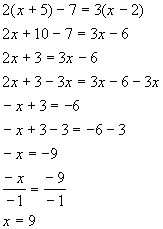
What would be the reasons for step #1, #2, #7, and #8?
#1 - Given
#2 - Distributive Property
#7 - Simplify
#8 - Division Property
Finish the Proof:
Given: 4x - 5 = 15
Prove: x = 5
Finish the Proof:
Given: 4x - 5 = 15
Prove: x = 5
| 1. 4x - 5 = 15 | 1. Given |
| 2. 4x - 5 + 5 = 15 + 5 | 2. Addition Property |
| 3. 4x = 20 | 3. Simplify |
| 4. 4x/4 = 20/4 | 4. Division Property |
| 5. x = 5 | 5. Simplify |
Given: 3x + 2(x - 4) = 7x - 6 Prove = x = -1
|
1. 3x + 2(x - 4) = 7x - 6 |
1. Given |
|
2. 3x + 2x - 8 = 7x - 6 |
2. |
|
3. 5x - 8 = 7x - 6 |
3. Simplify |
|
4. 5x - 7x - 8 = 7x - 7x - 6 |
4. |
|
5. -2x - 8 = -6 |
5. |
|
6. |
6. Addition Property |
|
7. -2x = 2 |
7. |
|
8. |
8. Division Property |
|
9. x = -1 |
9. |
Given: 3x + 2(x - 4) = 7x - 6 Prove = x = -1
|
1. 3x + 2(x - 4) = 7x - 6 |
1. Given |
|
2. 3x + 2x - 8 = 7x - 6 |
2. |
|
3. 5x - 8 = 7x - 6 |
3. Simplify |
|
4. 5x - 7x - 8 = 7x - 7x - 6 |
4. |
|
5. -2x - 8 = -6 |
5. |
|
6. |
6. Addition Property |
|
7. -2x = 2 |
7. |
|
8. |
8. Division Property |
|
9. x = -1 |
9. |
2. Distributive Property
4. Subtraction Property
5. Simplify
6. -2 - 8 + 8 = -6 + 8
7. Simplify
8. -2x/-2 = 2/-2
9. Simplify
Tell which definition, postulate, or theorem gives the justification.

AB = CD
Tell which definition, postulate, or theorem gives the justification.
AB = CD
Definition of congruent segments
Tell which definition, postulate, or theorem gives the justification.
Given: m<ABC = m<CBD = 180
Conclusion: <ABC & <CBD are supplementary
Tell which definition, postulate, or theorem gives the justification.
Given: m<ABC = m<CBD = 180
Conclusion: <ABC & <CBD are supplementary
Definition of Supp Angles
Tell which definition, postulate, or theorem gives the justification.
Given: B is in the interior of <ACD
Conclusion: m<ACB + m<BCD = m<ACD
Tell which definition, postulate, or theorem gives the justification.
Given: B is in the interior of <ACD
Conclusion: m<ACB + m<BCD = m<ACD
Angle Addition Postulate
Determine the next logical conclusion and the justification for that conclusion.
Given: HI = 8, IJ = 8
Determine the next logical conclusion and the justification for that conclusion.
Given: HI = 8, IJ = 8
Conclusion: HI = IJ
Justification: Transitive Property
Determine the next logical conclusion and the justification for that conclusion.
Given: <1 and <2 are complementary
Determine the next logical conclusion and the justification for that conclusion.
Given: <1 and <2 are complementary
Conclusion: m<1 + m<2 = 90
Justification: Definition of Complementary Angles

Angle Addition Postulate
Write the segment addition postulate statement for the following diagram.

Write the segment addition postulate statement for the following diagram.
AB + BC = AC
What is the ONE reason that allows you to go from the Given to the Prove statement.

What is the ONE reason that allows you to go from the Given to the Prove statement.
Congruent Supplements Theorem

b. Definition of congruent segments
3. AB = EF
d. Definition of congruent segments
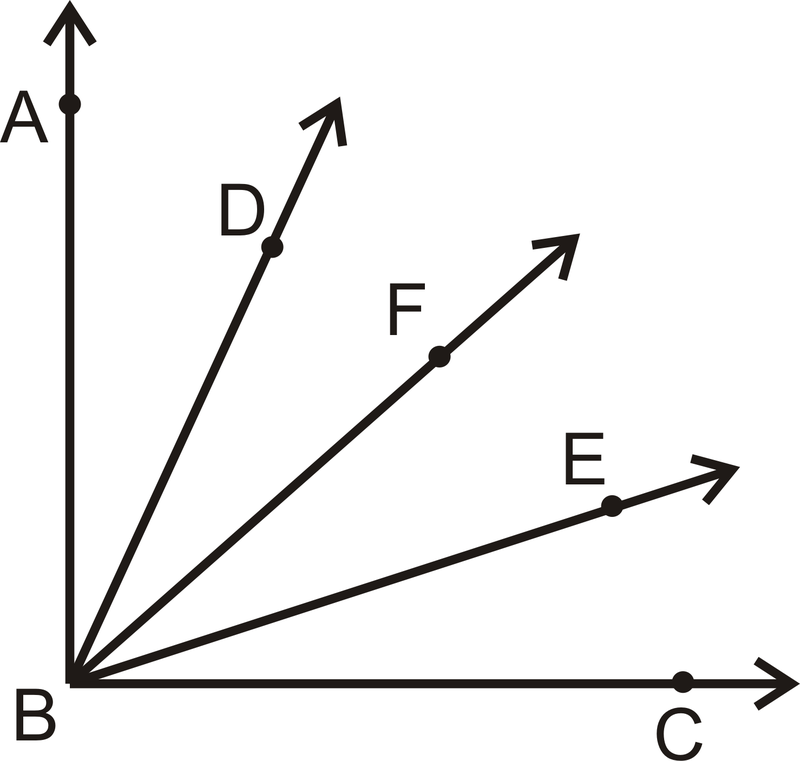
Given: m<ABD = m<EBC
Prove: m<DBC = m<ABE
|
1. m<ABD = m<EBC |
1. Given |
|
2. m<ABD + m<DBC = m<ABC m<EBC + m<ABE = m<ABC |
2. |
|
3. m<ABD + m<DBC = m<EBC + m<ABE |
3. |
|
4. m<ABD + m<DBC = m<ABD + m<ABE |
4. |
|
5. m<DBC = m<ABE |
5. |
Given: m<ABD = m<EBC
Prove: m<DBC = m<ABE
|
1. m<ABD = m<EBC |
1. Given |
|
2. m<ABD + m<DBC = m<ABC m<EBC + m<ABE = m<ABC |
2. |
|
3. m<ABD + m<DBC = m<EBC + m<ABE |
3. |
|
4. m<ABD + m<DBC = m<ABD + m<ABE |
4. |
|
5. m<DBC = m<ABE |
5. |
2. Angle Addition Postulate
3. Substitution or Transitive Property
4. Substitution
5. Subtraction Property
Write this statement and reason in a sentence.
| AB = CD | Def of cong seg |
Write this statement and reason in a sentence.
| AB = CD | Def of cong seg |
AB = CD by the definition of congruent segments.
Write this as a two column proof
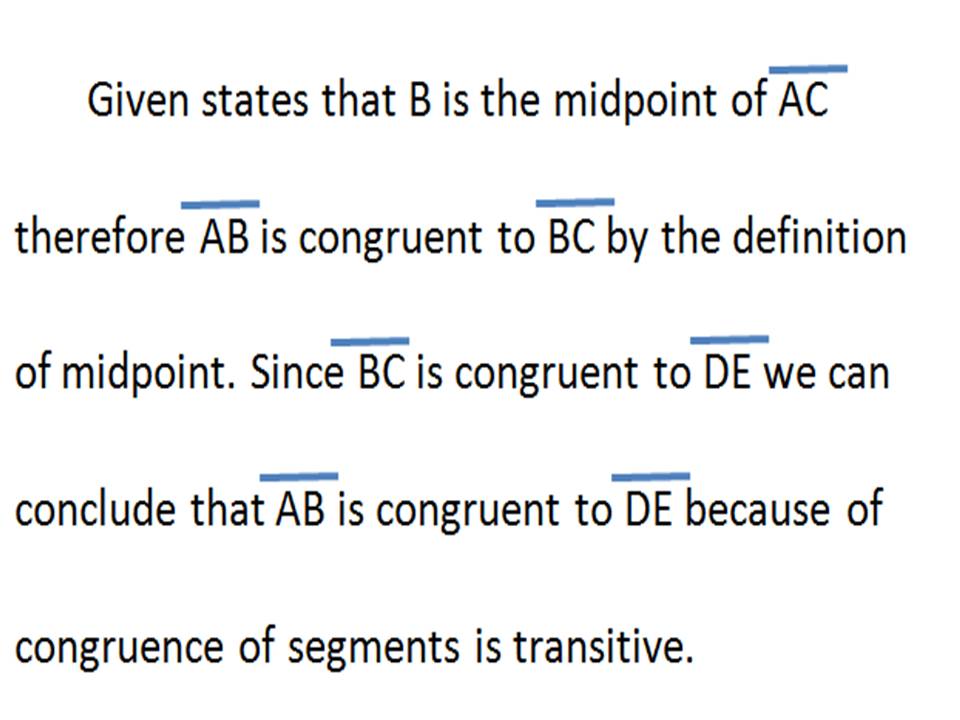
Write this as a two column proof
| B is the midpt of AC | Given |
| AB cong BC | Def of midpt |
| BC cong DE | Given |
| AB cong DE | Transitive Property |
Write this as a paragraph proof.

Write this as a paragraph proof.
Train tickets and a donut receipt were given. By looking at the receipt, it could be seen that Lisa bought the donuts. Looking at the time log, Henry ate a donut but was on time. Lisa was also on time because the donuts arrived before Henry who ate a donut.
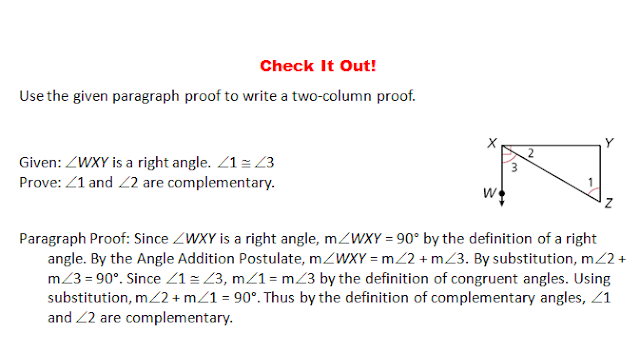
| <WXY is a right angle | Given |
| m<WXY = 90 | Definition of a right angle |
| m<WXY = m<2 + m<3 | AAP |
| m<2 + m<3 = 90 | Subst |
| <1 cong <3 |
Given |
| m<1 = m<3 |
Def of cong angles |
| m<2 + m<1 = 90 |
subst |
| <1 and <2 are comp |
Def of comp angles |
Write a paragraph proof:
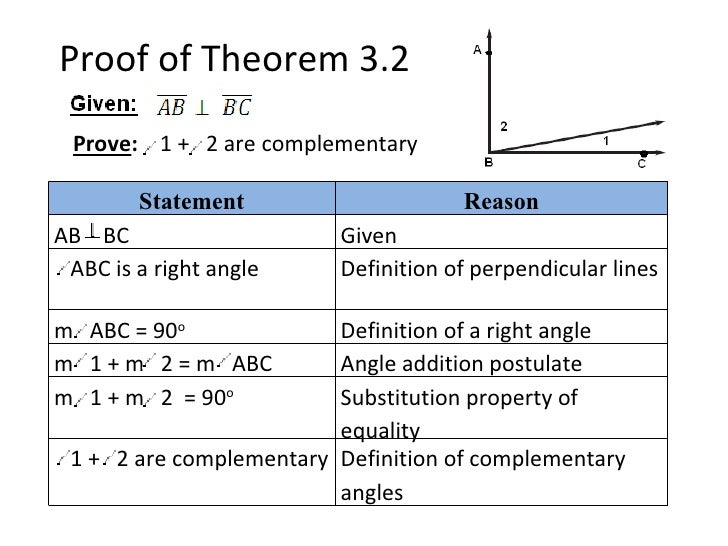
Write a paragraph proof:
We are given that AB is perpendicular to BC. By the definition of perpendicular lines, <ABC is a right angle. The m<ABC is 90 by the definition of a right angle. m<1 + m<2 = m<ABC by the angle addition postulate. By substitution, m<1 + m<2 = 90. Finally, <1 and <2 are complementary angles by the definition of complementary angles.
If AC = 62, find x. Show your work.
AB = 3x-4 and BC = 3x - 4.

If AC = 62, find x. Show your work.
AB = 3x-4 and BC = 3x - 4.
3x - 4 + 3x - 4 = 62
6x - 8 = 62
6x = 70
x = 70/6

|
|
|
|
| ||||||||||||||||||||||||||||||
|
|
|
|
|
||||||||||||||||||||||||||||||



What Would You Like To Risk?
|
|
|
|
|
||||||||||||||||||||||||||||||
|
|
|
|
|
||||||||||||||||||||||||||||||
|
|
|
|
|
||||||||||||||||||||||||||||||
|
|
|
|
|
||||||||||||||||||||||||||||||
Review Game Info:

You must save this address to be able to find and share your game!